On
January 4th, 1965,
another historic milestone was reached in contemporary music.
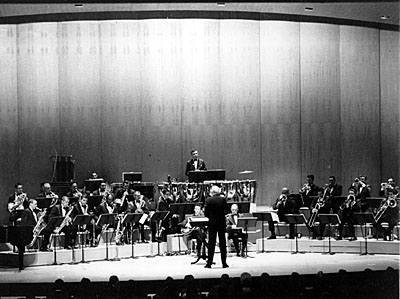 For
on that landmark
evening the Los Angeles Neophonic Orchestra, the world's only permanent
resident orchestra devoted to contemporary music, gave the first of 11
concerts in The Pavilion of The Los Angeles Music Center.
For
on that landmark
evening the Los Angeles Neophonic Orchestra, the world's only permanent
resident orchestra devoted to contemporary music, gave the first of 11
concerts in The Pavilion of The Los Angeles Music Center.
Significantly
for contemporary music, another opportunity for innovative expression
had
arrived. In a dazzling blend of imaginative writing and superb
musicianship
the Neophonic Orchestra presented dramatic evidence that it was quite
capable
of offering the listener a unique musical experience.
For
those who
had followed Stan Kenton's eclectic career the announcement that he had
been invited to premiere the Neophonic Orchestra at Los Angeles'
multi-million
dollar Music Center came as one more victory over the many slights
contemporary
music had been subjected to over the years.
Who
can forget the Carnegie Hall concert of 1948!
Kenton
was permitted
to perform in that venerable concert hall with the stipulation he go on
at midnight. Carnegie Hall's management insisted their conservative,
classically-oriented
music patrons would be offended if a ‘jazz concert’ (especially one by
Stan Kenton) was scheduled at the more traditional curtain time of 8:00
PM. Imagine their surprise when every seat in the house, including 300
folding chairs placed upon the stage, were sold-out in 12-hours!
Seventeen
years
later that same type enthusiastic support for any new musical direction
Kenton might take was still very much in evidence. The 11 Neophonic
concerts
performed in 1965, 1966 and 1968 proved conclusively that audiences
would
support a new musical concept which challenged them when given the
opportunity.
A music that was compelling, inventive and very definitely on the
cutting
edge.
These
six compositions,
selected from the more than 35 original compositions which received
their
world premieres during those three triumphal seasons, underscore the
stunning
harmonies, explosive rhythms and impeccable solo work which became a
hallmark
of the Los Angeles Neophonic Orchestra.
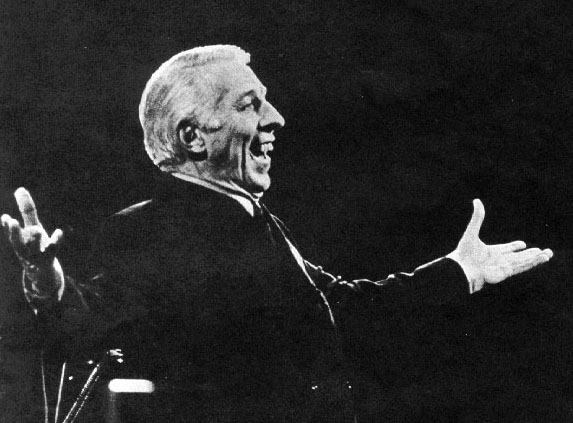 For
those who
questioned why Kenton felt the need to radically alter his Orchestra’ s
musical architecture by forming the Neophonic Orchestra, the reason was
simple. He felt contemporary music, and jazz in particular had
metamorphisized
itself through so many different styles, permutations and
instrumentation’s,
that the term ‘jazz’ was less meaningful. Jazz had become such a
catch-all
phrase for all types of contemporary music; from ballads to blues;
Kenton’s
own ‘progressive jazz’ to Bop, that any attempt to build upon
traditional
forms was not only restrictive, but impossible.
For
those who
questioned why Kenton felt the need to radically alter his Orchestra’ s
musical architecture by forming the Neophonic Orchestra, the reason was
simple. He felt contemporary music, and jazz in particular had
metamorphisized
itself through so many different styles, permutations and
instrumentation’s,
that the term ‘jazz’ was less meaningful. Jazz had become such a
catch-all
phrase for all types of contemporary music; from ballads to blues;
Kenton’s
own ‘progressive jazz’ to Bop, that any attempt to build upon
traditional
forms was not only restrictive, but impossible.
Interestingly,
this was not the first time Stan Kenton had elected to reshape his
library
and instrumentation and move the Orchestra in an entirely different
direction.
1950, without a doubt, will long be remembered in music circles as the
year he impressed audiences and critics with his 40-piece ‘Innovations
in Modern Music Orchestra’.
Structured
along
the lines of a miniature symphony -- woodwinds, violins, cellos and a
megatherin
timpani section augmented his primary 19-piece orchestra –
‘Innovations’
was described by critics as the first positive attempt to begin
smoothing
over the gap that had long existed between jazz and classical
music.
Although
the ‘Innovations’
Orchestra enjoyed an unprecedented success, the melding together of the
two forms was short-lived. For some, it as neither jazz, nor classical,
but an exploitation of one while demanding the rigorous disciplines of
the other. After weathering two short, but lively seasons marked by a
storm
of critical controversy, tempered by rave reviews from his audiences,
‘Innovations’
ceased to function as an interpreter of contemporary music.
And
so the search continued.
In
New York, Gunther
Schuller, John Lewis and George Russell began experimenting with ‘Third
Stream’ music, which although a throwback to the classical tradition
was
yet another meaningful attempt to combine two precise forms into one in
an effort to expand upon them.
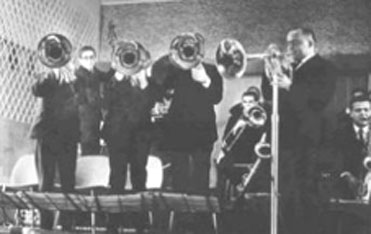 Simultaneously
in Los Angeles Kenton went through a trial and error period of
instrumentation
in which he added five E-flat trumpets to the Orchestra’s already
muscular
10-man brass section. When that fell short of providing the contrasting
tonal patterns he wanted, he changed the five E-flat trumpets to five
German
flugelhorns. When that, too, left a void he discovered almost by
accident,
that a brace of four Conn mellophoniums (alto brass horns keyed in F)
precisely
captured that elusive color range between the trumpets and trombones he
had been seeking for so long.
Simultaneously
in Los Angeles Kenton went through a trial and error period of
instrumentation
in which he added five E-flat trumpets to the Orchestra’s already
muscular
10-man brass section. When that fell short of providing the contrasting
tonal patterns he wanted, he changed the five E-flat trumpets to five
German
flugelhorns. When that, too, left a void he discovered almost by
accident,
that a brace of four Conn mellophoniums (alto brass horns keyed in F)
precisely
captured that elusive color range between the trumpets and trombones he
had been seeking for so long.
Kenton
toured
for three years with the 'Mellophonium Orchestra' and played to
capacity
houses both here and on the continent. Thanks in large part to Kenton’s
own deft touch and notable contributions from Bill Holman, Ralph
Carmichael,
Johnny Richards, Gene Roland, Dee Barton and Lennie Niehaus the library
featured some of the most driving and melodic writing ever conceived.
But,
like all
creative pathfinders, the time had once again arrived for him to
elevate
his music into yet another dimension.
Just
before leaving
for England in the winter of 1963, Kenton decided he would remain in
Los
Angeles for 18-months so he could form an altogether different
orchestra.
One which could be permanently located in Los Angeles and would utilize
many of the people who, from 1941 to present day, had graduated from
the
band and were playing, composing and arranging for the television and
film
industries.
Notably,
this
recording is a tribute to not only Stan Kenton’s vision, but to
everyone
who helped make the Neophonic Orchestra a reality and skillfully shaped
it into one of the most daring and successful ventures ever undertaken
by a performer.
Don’t
be surprised
when the Neophonic’s clarion trumpet calls, robust trombone passages
and
soaring saxophone runs begin swirling about you that you, too, sense
the
same exhilaration these musicians experienced on their way to January
4,
1965; a most historic date for music.
And
for you.